
Mouse Droppings vs. Rat Droppings: How to Tell What You Found
You pull a bag of dog food away from the garage wall and find a scatter of small dark specks along the baseboard. Or you open the cabinet under the kitchen sink and notice several larger pellets on the shelf liner.
Rodent droppings are often the first clear evidence homeowners find. Their size, shape, quantity, and location can help determine whether you are likely dealing with mice or a larger rodent.
Colorado properties can encounter house mice, deer mice, wood rats—commonly called pack rats—Norway rats, and roof rats. Their droppings do not all look or accumulate in exactly the same way. However, there can be overlap, so droppings should be considered alongside where they were found and other evidence in the area.
EnviroPest has been solving rodent problems in Colorado homes since 1965. Examining droppings and the surrounding area is an important part of determining what has been using the property and where professional attention is needed.
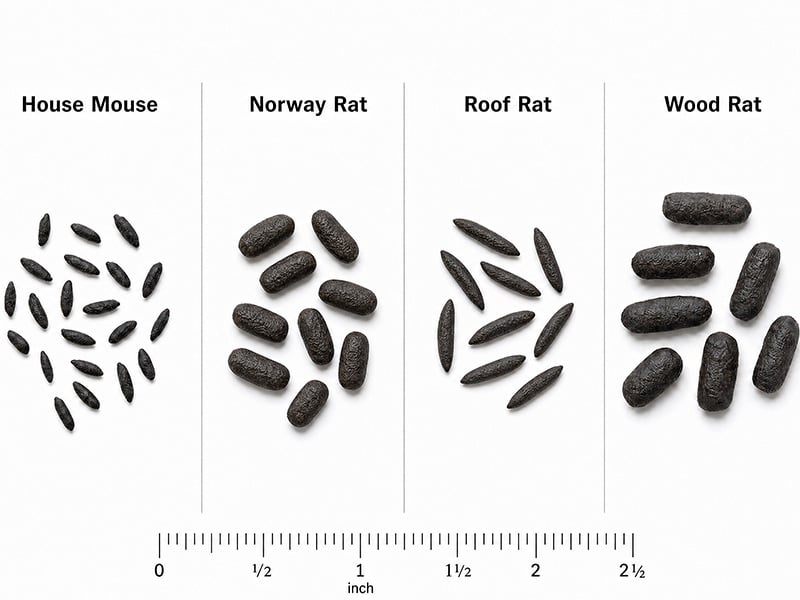
Illustrative comparison only. The size and shape of rodent droppings can overlap.
What Mouse Droppings Look Like
Mouse droppings are small, narrow, and usually pointed at one or both ends. Most are approximately 1/8 to 1/4 inch long and are often compared to dark grains of rice.
Mice can leave dozens of droppings in a day. Rather than finding one concentrated pile, you may notice many small droppings scattered across areas the animals have used.
Common places to find mouse droppings include:
-
Pantry and cabinet corners
-
Kitchen drawers
-
Beneath sinks
-
Behind appliances
-
Along garage walls
-
Near stored pet food
-
Inside boxes, boots, and other stored items
-
Around water heaters and utility areas
Numerous small, narrow droppings in a pantry, drawer, or cabinet strongly suggest mouse activity. However, their presence does not reveal exactly how many mice are inside. One mouse can leave considerable evidence over time.
Learn more about the species commonly found around Colorado homes on our mouse identification page.
What Rat Droppings Look Like
Droppings from rats and wood rats are noticeably larger and thicker than mouse droppings. They are typically 1/2 to 3/4 inch long, though their exact size and shape can vary.
Finding substantially larger droppings strongly suggests that you are not dealing with a typical house mouse. Determining which larger rodent left them requires looking at their general appearance, distribution, and location.
Norway Rat Droppings
Norway rat droppings are generally thick and capsule-shaped, with ends that appear blunt or rounded. Some may have a slight curve.
Because Norway rats generally spend more time at or near ground level, their droppings are more likely to appear in:
-
Basements
-
Crawl spaces
-
Garage corners
-
Along foundation walls
-
Behind ground-level appliances
-
Beneath decks or sheds
These locations provide useful context, but droppings alone cannot conclusively identify a Norway rat.
Roof Rat Droppings
Roof rat droppings tend to be slimmer than Norway rat droppings and often taper toward the ends. They may be straight or gently curved.
Roof rats are strong climbers, so larger droppings found in elevated areas may suggest roof rat activity. Possible locations include:
-
Attics
-
Rafters
-
Upper storage areas
-
Ceiling joists
-
Tops of ductwork
-
Elevated garage shelves
The height of the evidence can help narrow down the possibilities, but it should be considered with other signs found in the area. EnviroPest’s broader mouse-and-rat comparison also identifies roof rats with upper areas and Norway rats with ground-level spaces.
Wood Rat Droppings
Wood rats are native Colorado rodents commonly called pack rats. Their droppings are generally larger and thicker than mouse droppings, often with relatively rounded ends. Their appearance can overlap with droppings from other larger rodents, making the surrounding evidence especially important.
Wood rat droppings may accumulate in concentrated areas near a repeatedly used shelter, ledge, shed corner, or midden. A midden is an area where a wood rat has gathered sticks, plant material, insulation, or other objects.
Possible locations include:
-
Detached garages
-
Sheds and outbuildings
-
Barns
-
Woodpiles
-
Stored equipment
-
RVs and other infrequently used vehicles
-
Areas near gathered sticks or nesting material
A concentrated collection of larger droppings near gathered material can suggest wood rat activity. The size of the collection does not reveal how many animals are present and may instead reflect how long the area has been used.
EnviroPest’s rat identification page provides more information about wood rats, Norway rats, and roof rats in Colorado.
How to Compare Rodent Droppings
Size is usually the most useful starting point.
Droppings approximately the size of a grain of rice are more likely to have come from a mouse. Pellets that are clearly longer and substantially thicker suggest a rat, wood rat, squirrel, or another larger animal.
Next, look at how the droppings are distributed.
Mouse droppings are often scattered across drawers, shelves, wall edges, and other areas the animals have used. Norway and roof rat droppings may also appear along frequently used areas, although each pellet is considerably larger.
Wood rat droppings can accumulate more heavily near a shelter, midden, ledge, or repeatedly used corner. A concentrated area of larger droppings accompanied by sticks, vegetation, insulation, or collected objects is more suggestive of a wood rat than the droppings alone.
Location provides another clue:
-
Kitchen drawers, cabinets, pantries, and small stored items: More likely mice
-
Basements, crawl spaces, and ground-level foundation areas: Could indicate Norway rats
-
Attics, rafters, and elevated structural areas: Could indicate roof rats
-
Sheds, detached garages, woodpiles, and areas near a midden: Could indicate wood rats
These are clues rather than guarantees. Rodents do not always remain in their most typical locations, and waste from different animals can overlap in size and appearance.
For a broader comparison of the animals themselves, read about the differences between mice and rats. Colorado homeowners can also learn about the differences between deer mice and house mice.
Can Droppings Tell You Whether Rodents Are Still Active?
The appearance of rodent droppings can offer clues, but it cannot establish their exact age.
Newer droppings sometimes appear darker, while older material may look faded or dry. Humidity, dust, diet, cleaning products, and the surface beneath the droppings can all affect how they look.
Do not touch, crush, or break apart droppings to test their age or identify the animal.
New droppings found after an area has been cleaned safely provide stronger evidence of continuing activity. After following appropriate cleanup procedures, note the date and continue watching the area.
Additional droppings in the same place confirm that rodents are still using it. A lack of new evidence in one location is encouraging, but it does not rule out activity elsewhere in the home.
What Does the Number of Droppings Mean?
A large amount of waste can indicate that rodents have repeatedly used an area, but it does not provide an accurate head count.
One mouse can leave many droppings over a relatively short period. A single wood rat can also produce a substantial collection near a shelter that has been occupied for some time.
Droppings found across several cabinets, rooms, or levels of the home suggest that rodents have established regular routes through the structure. That does not necessarily mean each area is being used by a different animal.
What matters most is whether new droppings continue to appear, whether they are confined to one area, and whether there are other signs nearby. A professional inspection can put those clues together without relying on the number of pellets alone.
Do Not Sweep or Vacuum Rodent Droppings
Do not dry-sweep or vacuum rodent droppings, urine, or nesting material. Disturbing dry waste can send contaminated particles into the air.
This is especially important in Colorado because deer mice can carry the virus that causes hantavirus pulmonary syndrome. Any accumulation of unidentified rodent waste should be handled cautiously, particularly in an enclosed shed, crawl space, cabin, garage, or outbuilding.
The Centers for Disease Control and Prevention recommends wearing rubber or plastic gloves and thoroughly wetting the droppings and surrounding area with an EPA-registered disinfectant. Let the disinfectant remain in place for the contact time listed on its label, then wipe up the waste with paper towels. Do not sweep or vacuum it while dry. Review the CDC’s complete rodent-cleanup instructions.
Enclosed spaces should be ventilated before cleanup begins. Heavy contamination may require additional protective equipment or professional cleanup.
Our article about how rodents affect indoor air quality and health explains why accumulated waste should not be ignored.
Why Droppings Can Return After Cleanup
Cleaning removes the visible waste, but it does not remove the rodent or close the opening it used to get inside.
A mouse can squeeze through a gap approximately 1/4 inch wide—about the diameter of a pencil. Larger rodents can use damaged vents, garage-door corners, gaps around utility lines, foundation openings, roofline gaps, and other vulnerable areas.
When those openings remain accessible, new droppings can appear after the original waste has been removed.
A complete rodent solution requires more than cleanup. The animal must be identified, active areas must be located, likely entry points must be addressed, and the property should continue to be monitored for new activity.
How EnviroPest Handles Rodent Problems
Mouse and rat coverage is included in our Colorado’s Choice SMART Service.
This comprehensive residential pest control plan covers more than 30 pests, including mice and rats, and provides:
-
Four seasonal service visits
-
Year-round pest protection
-
Rodent control
-
Exclusion
-
24/7 digital rodent monitoring
-
Free re-treatment service for covered pests
EnviroPest uses the Anticimex SMART system to monitor for rodent activity continuously rather than relying only on what happens during a scheduled service visit. The current EnviroPest service page confirms these plan features.
Service starts with an inspection of the droppings and other available evidence. Our technicians determine the likely rodent, identify which areas it has been using, look for possible access points, and develop the appropriate plan for the property.
When wood rats are involved, the inspection may also need to account for outdoor shelters, middens, stored materials, or other conditions keeping them near the structure.
Continuous monitoring can detect new activity before another collection of droppings appears in a pantry, garage, or drawer.
When rodents are getting in through gaps around the foundation, roofline, vents, garage, or utility openings, EnviroPest may also recommend Enviro Guard. This professional exclusion service seals accessible entry points using durable materials designed to help keep rodents and other pests out.
EnviroPest serves homeowners in Denver, Colorado Springs, Fort Collins, and communities across the Front Range and Northern Colorado.
Frequently Asked Questions
Not always. Size can usually help distinguish likely mouse droppings from those of a larger rodent. Shape, distribution, and location provide additional clues, but waste from wood rats, Norway rats, roof rats, squirrels, and other animals can overlap.
Not precisely. Older droppings may appear dry or faded, but moisture, dust, diet, and indoor conditions can change their appearance. New evidence after safe cleanup is a more dependable indication of continuing activity.
They can. Bat droppings may resemble mouse droppings, while squirrel droppings can overlap in size with waste from larger rodents. Location, distribution, noises, nesting evidence, and entry points are generally more useful than handling the waste to compare its texture.
Yes. One dropping does not establish how many mice are present, but it confirms that a rodent used that area. Check nearby cabinets, stored items, wall edges, appliances, and utility penetrations for additional evidence.
Wood rats are one possibility, especially when the damage is accompanied by a larger nest made from sticks, vegetation, insulation, or collected objects. Mice and other rodents can also enter engine compartments, so the droppings, nesting material, and surrounding area should all be considered.
Yes. Garages are common rodent entry areas because gaps can develop around overhead doors, utility penetrations, and the door leading into the living space. Pet food, birdseed, and stored belongings can also give rodents reasons to remain there.
Not Sure What Left the Droppings?
You do not have to identify the animal from one dropping or wait for more evidence to appear.
EnviroPest can inspect the affected areas, determine the likely rodent, identify possible entry points, and recommend the right solution for your home.
Contact EnviroPest to request a free quote.

Testimonials
GETTING STARTED IS AS EASY AS 1-2-3
REQUEST FREE ESTIMATE
Pest Solutions For Homes & Businesses
We understand that pest problems can be unsettling and frustrating, but the solution shouldn't be. For over 55 years, we've been helping folks right here in Colorado take care of ants, spiders, mice, mosquitoes, wasps, bed bugs, bats and most other creepy crawly things. We'll get there fast to solve the issue quickly and affordably - Guaranteed.


EnviroPest Blog & News
Why Crickets Are Getting Into Colorado Homes in Late Summer

West Nile Virus Is Back in Colorado: What Homeowners Should Know This Summer