
Termite Swarmers in Colorado: What Those Flying Insects Near Your Home Really Mean
It usually starts with something small. You notice a handful of winged insects near a window. Maybe a few are gathered around a basement light or piling up near a sliding glass door. They look like flying ants — and honestly, that's what most people assume they are.
But if you're seeing this in the spring, especially after a warm day with some rain, there's a real chance those are termite swarmers. And that changes everything.
Here along the Front Range — Denver, Boulder, Fort Collins, Colorado Springs — subterranean termites are more common than most people realize. Every spring, we get a wave of calls from homeowners who spotted something flying and weren't sure what to make of it. Most of them thought they were looking at ants. Some caught it early. Others had colonies that had been active for years before anyone noticed.
What Termite Swarmers Actually Are
When a termite colony gets big enough — usually after a few years of growth — it sends out winged termites to mate and start new colonies. That's the swarm.
In Colorado, the eastern subterranean termite is the species we deal with most. They typically swarm from March through May, almost always during the day and usually after a warm rain. If conditions are right, hundreds of them can appear at once.
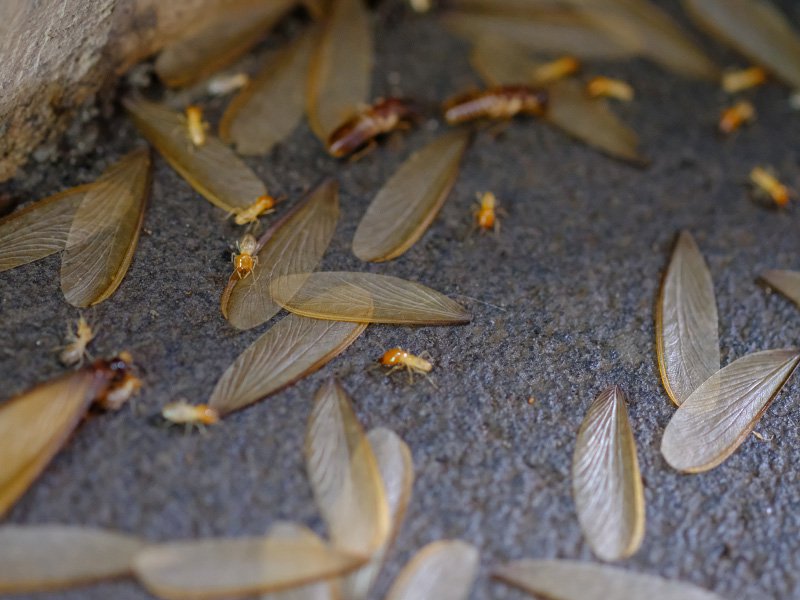
The swarm itself is over fast. Within an hour or so, they've paired off, dropped their wings, and disappeared into the soil. What they leave behind is a pile of small, translucent wings — often on windowsills, near doors, or along the foundation. One of the biggest signs we look for during spring inspections is those piles of shed wings. If you're finding them, a colony is close by.
Flying Ants or Termite Swarmers? How To Tell the Difference
This is the question we hear more than almost anything else in spring. At first glance, they really do look alike. But once you know what to look for, it's pretty straightforward.
Termite swarmers — sometimes called flying termites or winged termites — have a straight, thick body with no visible waist. Their four wings are all the same length, and they're pale or milky-looking. The antennae are straight. Flying ants have a pinched waist, a longer front pair of wings, and elbowed antennae with a clear bend.
Here's the big giveaway, though: termites shed their wings almost immediately after landing. If you're finding small piles of matching wings near your windows, doors, or foundation, that's not flying ants. That's a termite swarm that already happened.
A lot of the swarmer calls we get in Boulder and Loveland start the same way — someone finds a pile of tiny wings on a windowsill and doesn't think much of it until they see more. By that point, the colony has usually been active for a while. If you're not sure what you're seeing, give us a call. We'll take a look and tell you exactly what's going on.
Where Swarmers Show Up Around Colorado Homes
Swarmers can appear both inside and outside your home, and the location matters.
Signs of termite swarmers inside Colorado homes include finding them near windows, light fixtures, or in basements and crawl spaces. Indoor swarms are a serious concern — they usually mean a colony is already established inside or directly beneath your structure. We see this more often in older homes across Denver and Longmont where foundation cracks or gaps around utility lines give termites a way in. Homes with slab foundations can be especially tricky because activity happens underneath where you can't see it.
Outdoor swarms are common too, especially near the foundation, landscaping beds, tree stumps, fence posts, and firewood piles. We especially see termite activity around irrigated landscaping beds in otherwise dry Front Range neighborhoods — that extra moisture in Colorado's expansive clay soil creates exactly the conditions termites need.
In neighborhoods across Colorado Springs and Fort Collins, swarms around heavy mulch beds or railroad-tie retaining walls near the foundation are something we deal with regularly.
Either way, if you're seeing swarmers or their wings, it's worth having someone take a look. A colony big enough to produce swarmers has been growing for years — and the earlier it's found, the easier it is to stop.
Why Termite Swarmers Are a Serious Warning Sign
Subterranean termites work underground and inside wood, completely out of sight. By the time a colony starts sending out swarmers, it's typically been feeding on your home for three to five years. The National Pest Management Association estimates that termites cause $5 billion in property damage across the U.S. every year — and most homeowner's insurance won't cover it.
Our technicians regularly find damage in spots homeowners didn't even know were vulnerable. Baseboards that sound hollow. Door frames that crumble with light pressure. Soft spots in drywall that only show up during a careful inspection.
In older Front Range homes — especially around Denver, Boulder, and foothill communities — we often find damage near window trim and along the subfloor where moisture has softened the wood over time.
The damage is real, it adds up, and it doesn't get better by waiting. That's why we always recommend getting it checked sooner rather than later.
If You See Swarmers in Your Home
Don't panic, but don't ignore it either. Here's what we tell homeowners who call us after spotting termites with wings in their home:
Don't spray them and move on. Killing the swarmers doesn't address the colony. Save a sample or take a photo — it helps us confirm the species quickly. Look for shed wings near windows, doors, and along baseboards. And schedule an inspection soon. The swarmers themselves aren't doing the damage, but the colony that produced them is.
If you're not sure whether you're looking at winged termites or flying ants, we can tell you. That's what we're here for.
How EnviroPest Protects Your Home With Sentricon® System
When you call us about termite control, the first step is a thorough inspection — and it's free. One of our licensed specialists will check your foundation, crawl spaces, basement, and other areas where termite activity is commonly found. We'll tell you exactly what we find.
If treatment is needed, EnviroPest uses the Sentricon® System with Always Active™ technology. Sentricon stations are installed in the soil around the perimeter of your home with termite bait already in place. The stations do not attract termites. Instead, foraging termites encounter the bait as they search for food, feed on it, and share it with other termites in the colony. The active ingredient prevents termites from successfully molting, ultimately eliminating the colony, including the queen.
The stations remain in place after the colony is eliminated and are serviced on an ongoing basis, providing continuous protection against future subterranean termite colonies.
EnviroPest has protected Colorado homes since 1965. We also offer certified termite inspections for real estate transactions and financing options for homeowners who prefer to spread out treatment costs.
If you're seeing termite swarmers, shed wings, or other signs of activity around your home, contact EnviroPest to schedule a free termite inspection.
Frequently Asked Questions About Termite Swarmers in Colorado
Can termites come back after treatment?
They can. Colorado's soil supports multiple termite colonies in any given area, so new colonies can move in over time even after one is eliminated. That's why the Trelona ATBS stations stay in the ground year-round — they continuously intercept termites, not just during the initial treatment.
How long does Sentricon® take to eliminate a termite colony?
In many cases, Sentricon® can eliminate a termite colony within 90 days. Once termites find and feed on the bait, they share it with other members of the colony. The bait prevents termites from molting, causing the colony to decline until it can no longer sustain itself. Timing can vary depending on termite activity and how quickly they discover the bait stations.
Do I need a termite inspection before selling my home in Colorado?
Colorado doesn't legally require one, but many lenders — especially VA and FHA programs — do before approving financing. Even when it's not required, a certified inspection gives buyers confidence and can keep a deal from falling apart. EnviroPest offers certified termite inspections for exactly this purpose.
What are mud tubes, and should I be worried?
Mud tubes are narrow, dirt-colored tunnels that termites build along foundations and walls to travel between their colony and their food source. They're about the width of a pencil. If you find them on your foundation or in your crawl space, that's a strong sign of active termite activity. Schedule an inspection.
Are there times of year when termite damage is worse?
Termites in Colorado feed year-round — they don't hibernate. Colonies are most active during warmer months, which is also when they produce swarmers. But the damage itself builds slowly and steadily, which is why most homeowners don't notice it until it's significant. Year-round monitoring catches activity before it adds up.
Protect Your Colorado Home From Termites
Don't wait for termite damage to get worse. If you've spotted swarmers, shed wings, or anything that doesn't look right, EnviroPest is here to help.
Request your free termite estimate online or by calling (719) 631-2469. We've been protecting Colorado homes since 1965 — let us protect yours.

Testimonials
GETTING STARTED IS AS EASY AS 1-2-3
REQUEST FREE ESTIMATE
Pest Solutions For Homes & Businesses
We understand that pest problems can be unsettling and frustrating, but the solution shouldn't be. For over 55 years, we've been helping folks right here in Colorado take care of ants, spiders, mice, mosquitoes, wasps, bed bugs, bats and most other creepy crawly things. We'll get there fast to solve the issue quickly and affordably - Guaranteed.


EnviroPest Blog & News
Why Are Spiders and Earwigs Showing Up Upstairs in Greeley Homes?
Why Crickets Are Getting Into Colorado Homes in Late Summer